
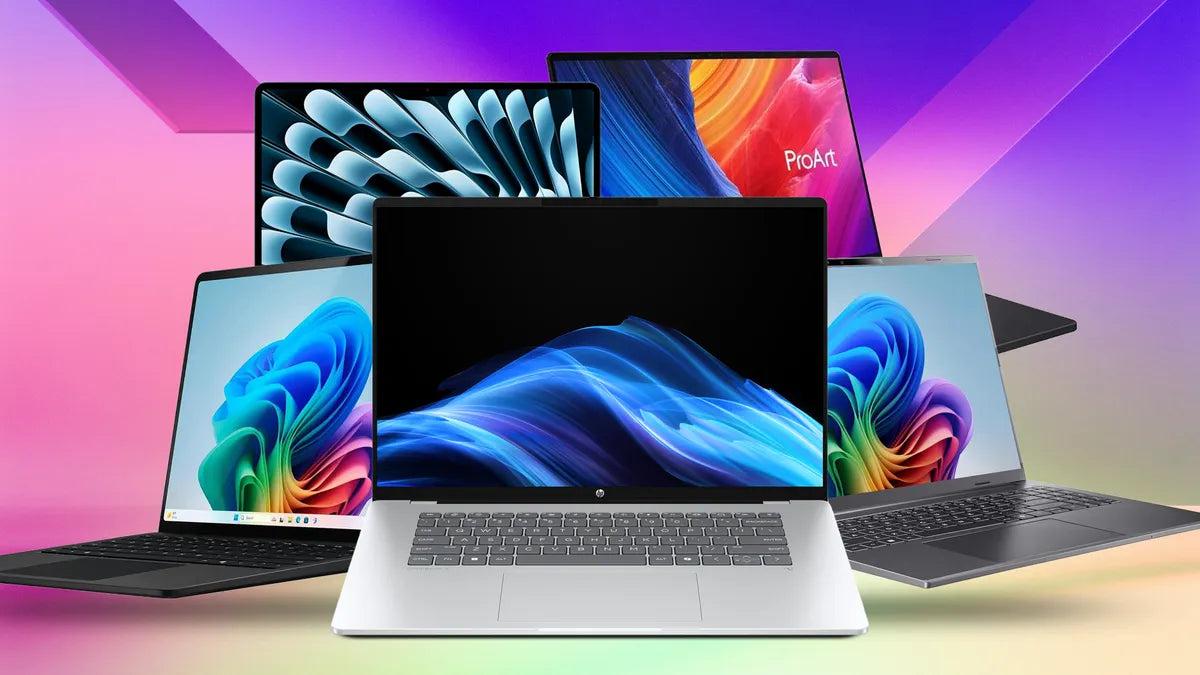
Most laptop confusion in Egypt comes from one mistake — shopping by brand before use case. A gaming laptop is not a better student laptop just because it costs more. This guide matches the right laptop to the right buyer: gaming, business, student, or creator. We also break down why the same model can differ by thousands of EGP across stores — and what to do about it before you spend.
Introduction
If you've searched for laptops in Egypt recently, you've probably run into the same frustrating experience: three different stores, three different prices for the same model, and zero clarity on why. One shop quotes you 32,000 EGP. Another lists it at 27,500. A third throws in a bag and still comes in lower. That's not a sale — that's the Egyptian laptop market in 2026, and it catches buyers off guard every single day.
The good news is that 2026 is genuinely one of the best years to buy a laptop here. NVIDIA's RTX 50-series has arrived in laptop form, AMD's Ryzen AI chips are competitive across every tier, and ASUS and MSI have both pushed their lineups hard. The Snapdragon X Elite generation has also introduced a new class of ultra-light productivity machines with smartphone-level battery life that are now widely available locally.
But the wider the range, the easier it is to overspend on the wrong thing. This guide breaks down every serious laptop category available in Egypt right now — organized by what you actually need, not just what spec sheet looks most impressive.
Why Laptop Prices in Egypt Vary So Much
Laptop prices in Egypt are not set by the manufacturer — they're shaped by import costs, EGP exchange rate shifts, customs duties, and what warranty tier a given retailer is offering. A laptop sold with a grey-market import and no local service backing will almost always be priced lower than the same unit sold with an official two-year warranty. That price gap is real, but so is the risk of having nowhere to go if something goes wrong six months in.
There are three things worth knowing before you pay anything:
- Import and currency exposure. Most laptops in Egypt are imported, which means prices move with the exchange rate. A model priced today may be 10–15% more expensive if you wait three months, especially on flagship SKUs. This is not a sales tactic — it's a structural reality of the Egyptian tech market.
- Warranty tiers matter more than most buyers realise. Official warranty means the retailer is authorised to provide local service and replacement parts. Grey import warranty is manufacturer-backed only, and in practice, that often means shipping abroad for repairs. For anything above 20,000 EGP, official warranty is not optional — it's the actual cost of protecting your investment.
- Installment plans change the real-cost equation. XPRS offers 0% interest installment plans across its laptop range, which means a 36,000 EGP mid-range machine can run comfortably under 3,000 EGP per month. For most buyers, that's the smarter frame than comparing sticker prices.
The 4 Types of Laptops in Egypt — Matched to Real Use Cases
Before comparing any models, answer one question: what is this laptop actually doing every day? Egypt's laptop market in 2026 splits cleanly into four categories, and buying across category lines is the most common (and most expensive) mistake.
- Gaming laptops are built around GPU performance, high-refresh displays, and thermal headroom. They're heavy, run hot, and drain batteries in two to three hours under load. If you're not actively gaming, paying for an RTX 5060 is money left on the table.
- Business and productivity laptops (now increasingly "Copilot+ PCs") prioritise Neural Processing Units (NPUs) for AI-accelerated tasks, all-day battery life, and thin form factors. The ASUS Zenbook lineup and Lenovo ThinkPad represent this category best in Egypt right now.
- Student laptops need to survive a bag, a lecture hall, and four years of daily use. The priority is durability, weight, value, and enough processing power for software-heavy coursework. This is where the ASUS Vivobook range consistently punches hardest.
- Creator and design laptops sit between gaming and business — they need colour-accurate OLED displays, strong CPUs for rendering, and enough GPU to handle Adobe and DaVinci without dropping frames. This is the trickiest category to buy in Egypt because it's underserved by most local guides.
Best Laptops in Egypt for Gaming in 2026
The best gaming laptop in Egypt is the one that handles your target games at your target settings without thermal throttling into the floor by hour two — and in Cairo summers, that cooling question is not trivial.
- Budget tier (under ~25,000 EGP): ASUS TUF Gaming A15 — Ryzen 7 + RTX 3050 Military-grade durability certification, a thermal design that holds up under extended sessions, and enough GPU to handle modern titles on medium-to-high settings. The TUF A15 is the go-to recommendation for Egyptian university students who game. It doesn't lead the spec sheet, but it survives real-world use better than most competitors at this price.
- Mid-range (40,000–70,000 EGP): MSI Crosshair 16 HX AI — RTX 5060 GDDR7 This is the value-per-frame winner in 2026. The RTX 5060 on GDDR7 memory delivers QHD+ at 240Hz with DLSS 4 support that makes the frame rate advantage feel generational, not incremental. If you're upgrading from a 2021–2023 machine and want to stay relevant for four to five years, this is the tier to buy into.
- High-end (70,000 EGP+): ASUS ROG Strix SCAR 18 — RTX 5070 Ti / 5090 The SCAR 18 is not a laptop for everyone. It's a portable desktop replacement — 18 inches, ROG's Tri-Fan cooling system, 32GB RAM standard, and an RTX 5070 Ti or 5090 depending on configuration. For Cairo summers specifically, the Tri-Fan thermal design is one of the few systems that genuinely maintains sustained performance without throttling. If budget allows and you want a machine that won't feel limiting for five to six years, this is it.
Egypt heat note: Look for CPUs labelled with the "HX" suffix and cooling systems that use vapor chambers or multi-fan setups (MSI Cooler Boost 5, ROG Tri-Fan). Laptops without dedicated thermal headroom will throttle under sustained load in warm ambient temperatures — a real issue in Egyptian summers that no international review will flag for you.
Best Laptops in Egypt for Work and Business
The 2026 business laptop market in Egypt has shifted around one concept: the NPU. Neural Processing Units now handle background AI tasks — video call blur, real-time noise cancellation, local AI assistants — without touching the main CPU or hammering battery life. If you're buying a business laptop today and it doesn't have an NPU, you're buying last-generation thinking.
- ASUS Zenbook 14 (UX3405 / UX3407) — Intel Core Ultra 9 285H + OLED The best business laptop available in Egypt right now. It weighs 1.2kg, runs a 120Hz OLED touchscreen with genuine colour accuracy, and delivers battery performance that doesn't require carrying a charger to a full day of meetings. The Core Ultra 9 285H is fast enough to run creative workloads alongside standard office tasks without slowing down.
- Lenovo ThinkPad (13th Gen i5 / i7 variants) For teams that prioritise security and keyboard quality over display luxury, the ThinkPad remains the professional standard. ThinkShield security — physical webcam shutter, dTPM 2.0 encryption — matters for legal, finance, and government buyers. The keyboard is still the best in the category.
- Snapdragon X Elite models (ASUS Vivobook 16 X1607QA, Zenbook A14) Battery life up to 20+ hours. Instant-on. Fanless. These machines feel closer to a smartphone in daily use — they're always on, always fast for standard tasks, and genuinely light. The trade-off in Egypt is software compatibility: through Microsoft's Prism emulation layer, most x86 apps run fine, but niche or legacy professional software should be tested before committing. Ask at the counter before you buy.
Best Laptops in Egypt for Students
The student laptop question in Egypt is almost always framed wrong. Most students ask: "What's the most powerful laptop I can afford?" The right question is: "What's the most reliable laptop that handles my actual coursework and survives three years of daily use?"
- ASUS Vivobook range — the Egyptian student standard The Vivobook series covers more use cases, price points, and durability requirements than anything else available locally. The Vivobook 14 Flip handles presentations and note-taking well; the Vivobook 16 OLED is the pick for design, architecture, or media students. For general engineering or business students, the standard Vivobook 15 with a 13th Gen i5 and 16GB RAM is the sweet spot in 2026.
- On RAM: 8GB is a trap. In 2026, Windows 11 with a browser, Teams, and a few apps open will tax an 8GB machine. 16GB is the minimum worth buying. The performance difference between 8GB and 16GB in daily student use is not marginal — it's the difference between a machine that feels smooth and one that makes you wait. Any laptop sold with 8GB at this point is a cost-cutting decision by the manufacturer, not a recommendation.
On durability: Egyptian students carry their laptops daily — metro commutes, lecture halls, shared desks. ASUS TUF military-grade certification and the general build quality of the Vivobook mid-range hold up significantly better than ultra-thin alternatives that prioritise weight over structural resilience. A cracked chassis at month four is a worse deal than a slightly heavier laptop that lasts four years.
The 5 Specs That Actually Matter When Comparing Laptops in Egypt
When comparing any two laptops side-by-side, focus on these five things. Everything else is noise.
1. CPU — Generation and suffix matter. Intel Core Ultra (12th gen and above) and AMD Ryzen AI chips are the current generation. The "H" suffix means high-performance; "HX" means maximum performance with higher thermal requirements. For everyday use, Core Ultra 5 or Ryzen 5 7000-series is plenty. For gaming or heavy creative work, go HX.
2. RAM — 16GB minimum, 32GB for heavy work. This is not negotiable in 2026. 16GB handles everything from student coursework to light content creation. 32GB is standard on ROG and Zenbook flagships for a reason — if you're editing video, running VMs, or doing heavy multitasking, 32GB is where smooth starts.
3. Display — IPS 144Hz vs OLED. Choose IPS at 144Hz or above for gaming (motion clarity over colour depth). Choose OLED if you do creative work or watch a lot of high-quality content — the colour accuracy and contrast are genuinely superior and visible. Don't pay OLED prices for a gaming machine unless you need both.
4. Cooling — Egypt heat is a real variable. This is the one spec that no international review weights appropriately. HX-suffix processors generate more heat by design. In Egyptian ambient temperatures, vapour chamber cooling (MSI Vector, ROG SCAR) and tri-fan designs maintain performance under sustained load. Single-fan budget machines will throttle — check cooling specs before you buy, not after.
5. Warranty tier — official vs grey import. Ask specifically: is this an official ASUS / MSI / Lenovo warranty serviced locally? Or is it a manufacturer warranty that requires international coordination? For anything you're spending serious money on, official local warranty is not a bonus feature — it's part of the price you're paying.
Where to Buy Laptops in Egypt — and What to Watch Out For
The Egyptian laptop retail market in 2026 ranges from highly reputable to actively misleading, and the difference isn't always obvious from a storefront or website.
Three questions to ask before paying anything:
- Is this an official warranty, and what does local service cover? A genuine retailer can answer this clearly. Vague answers about "manufacturer support" are a warning sign.
- What is the actual installment structure? 0% interest installment (as offered through XPRS) means the price you see is the price you pay, spread over months. Other plans carry hidden processing fees — ask for the total cost in writing before signing.
- Is this the current regional SKU? Some grey-import laptops arrive with keyboards or power adapters configured for other markets. This matters for Arabic keyboard layout users and for voltage compatibility.
XPRS stocks the full ASUS and MSI lineup with official warranty, home delivery across Egypt, and 0% interest installment plans across the entire laptop range — gaming, business, and student categories included.
Conclusion
Buying a laptop in Egypt in 2026 is genuinely easier than it was two years ago — the local inventory is deeper, the financing options are better, and the hardware itself is stronger at every price tier. The decision that still trips people up is buying for the wrong use case, or getting a lower sticker price at the cost of warranty and support they'll need later.
Match your category first. Set your RAM floor at 16GB. Check the cooling spec if you're buying anything performance-oriented. And make sure the warranty is locally serviceable before you commit.
If you want to see the full range of laptops in Egypt available right now — with specs, current prices, and installment breakdowns — explore the XPRS collection. The right machine is there.
FAQ
Q: What is the best laptop brand in Egypt in 2026? T
here's no single answer — the best brand depends on your use case. ASUS leads across the most categories: TUF for gaming value, Vivobook for students, Zenbook for business professionals, and ROG for high-performance gaming. MSI is the stronger choice for gaming-specific builds, particularly at the mid-to-high tier. Lenovo ThinkPad remains the standard for corporate and security-sensitive environments.
Q: How much RAM do I need in a laptop in Egypt?
16GB is the practical minimum for any laptop bought in 2026. Windows 11 running standard apps, a browser, and productivity tools will use a significant portion of 8GB without any heavy tasks. For gaming, content creation, or running multiple applications simultaneously, 32GB is the better target. Upgradeability varies by model — check before buying if future RAM expansion matters to you.
Q: Why are laptop prices different across Egyptian stores?
Prices vary based on import costs, EGP exchange rate exposure, warranty tier (official vs grey import), and whether the seller is including accessories or extended service. The same model sold with an official local warranty from an authorised retailer will almost always cost more than a grey-import unit — and that difference is the cost of having local support if something goes wrong.
Q: Is it better to buy a gaming or productivity laptop in Egypt?
Depends entirely on what you actually do. Gaming laptops are optimised for GPU-heavy tasks and high-refresh displays — they're heavy, loud under load, and get 2–3 hours of battery on the road. Productivity laptops are light, quiet, and designed for 8–12 hours of real-world battery. Buying a gaming laptop for work is like buying a truck to commute: technically capable, practically inconvenient. Buy for your primary use case, not your aspirational one.
Q: Do laptops in Egypt come with an official warranty?
Not automatically — it depends on where you buy. Authorised retailers like XPRS provide official manufacturer warranties backed by local service. Some online and offline stores sell grey-import units with manufacturer-only warranties, which can be difficult to claim locally. Always confirm warranty type and what local service options are available before purchase.